

Myofascial release is a hands-on therapy that targets the fascia, the thin connective tissue wrapping around your muscles. When this tissue becomes tight or restricted, it creates pain, limits your movement, and can cause chronic discomfort that won’t go away with rest or stretching. This specialized technique applies gentle sustained pressure to release these restrictions and restore your body’s natural flexibility. You might experience relief from persistent muscle pain that has resisted other treatments.
This article explains how fascia becomes tight and painful, what happens during a myofascial release session, and which conditions respond best to this therapy. You’ll learn the difference between professional treatment and self-care techniques, and discover why needle-free approaches offer unique advantages. Whether you’re dealing with chronic pain, recovering from an injury, or trying to avoid surgery, understanding myofascial release can open new pathways to healing.
Why fascia becomes tight and painful
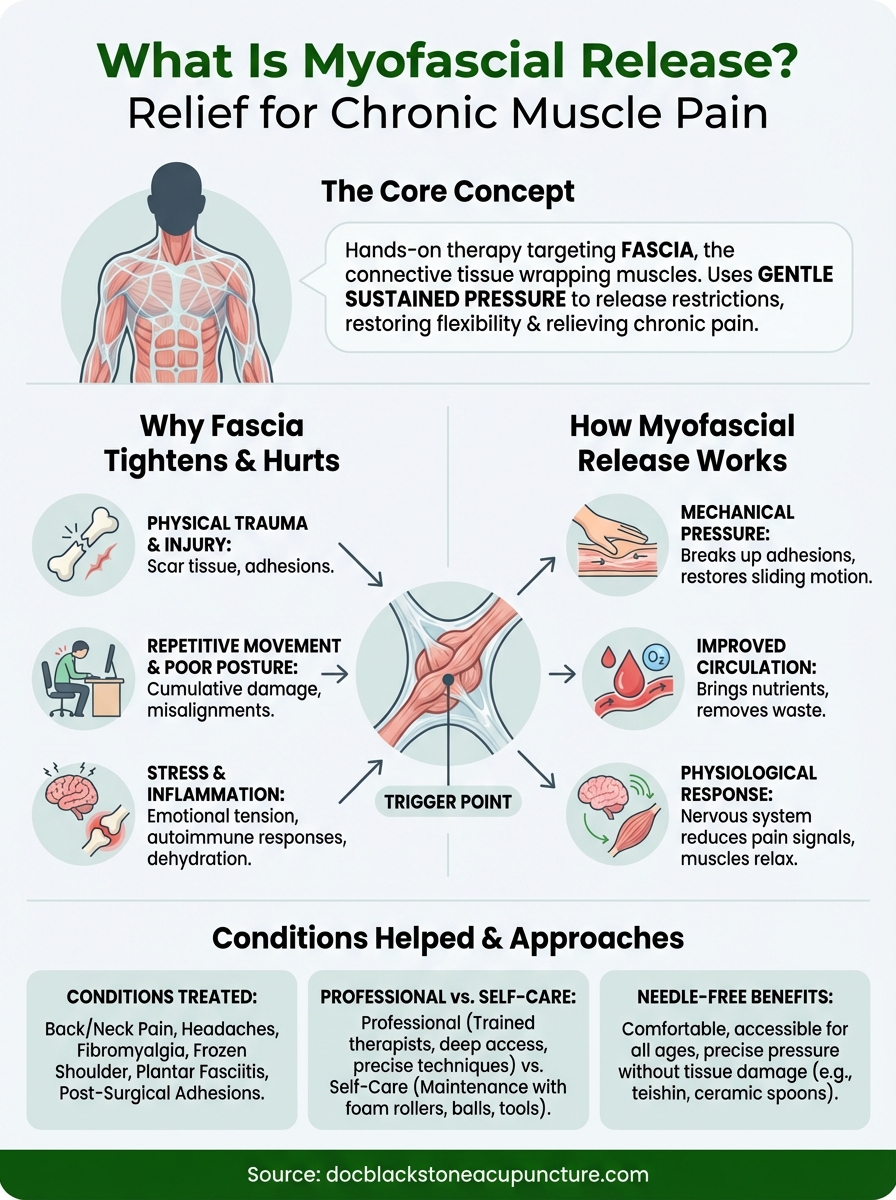
Your fascia should glide smoothly over your muscles, but daily stress, injury, and poor movement patterns cause this tissue to thicken and stick together. When fascia loses its flexibility, it creates trigger points and areas of restriction that pull on your muscles and nerves. These tight spots develop gradually, often without you noticing until the pain becomes chronic. Understanding what is myofascial release starts with recognizing why your fascia stops working properly.
Physical trauma and injury patterns
Direct injury creates immediate fascial restrictions that persist long after your original wound heals. When you sprain an ankle, strain a muscle, or undergo surgery, your body lays down scar tissue that binds the fascia to surrounding structures. This adhesion limits your range of motion and creates compensatory patterns throughout your body. You might favor one leg after an injury, which then causes your hip and lower back fascia to tighten from uneven weight distribution.
Repetitive movements at work or during sports create cumulative damage that’s harder to identify. Your fascia responds to constant stress by becoming denser and less pliable. Office workers develop tight chest and shoulder fascia from hunching over keyboards. [Athletes](https://docblackstoneacupuncture.com/athletic-recovery-techniques/) who repeat the same motion thousands of times create fascial restrictions in specific muscle groups. These patterns build slowly until you experience pain that seems to appear without any clear cause.
Stress and postural habits
Emotional tension translates directly into fascial tightness through a process you experience every day. When you feel stressed or anxious, your muscles contract and your fascia follows, creating lasting restrictions even after the stressful event passes. Your jaw, neck, and shoulders hold this tension most visibly. Chronic stress keeps your fascia in a perpetual state of contraction, reducing blood flow and creating painful knots.

Your body doesn’t distinguish between physical and emotional stress. Both create the same fascial restrictions.
Poor posture while sitting, standing, or sleeping forces your fascia to adapt to misaligned positions. When you slouch, your chest fascia shortens while your back fascia overstretches. This imbalance creates tension throughout your entire body. You carry your head forward, your shoulders round, and your fascia molds itself to these dysfunctional patterns. Breaking these habits requires both postural correction and fascial release.
Inflammatory responses
Inflammation from illness, autoimmune conditions, or food sensitivities causes your fascia to swell and stick together. Your immune system responds to perceived threats by flooding tissues with inflammatory chemicals. This process thickens your fascia and reduces its ability to glide smoothly. Conditions like fibromyalgia and chronic fatigue syndrome often involve widespread fascial inflammation that creates pain throughout your entire body.
Dehydration and poor nutrition deprive your fascia of the fluids and nutrients it needs to stay supple. Fascia contains a gel-like substance that requires adequate water intake to maintain its sliding properties. When you’re chronically dehydrated, this gel becomes sticky and dense, creating restrictions that limit your movement and cause discomfort.
How myofascial release relieves tension
Myofascial release works by applying sustained pressure to restricted areas of fascia, creating physical and biochemical changes that restore normal tissue function. A practitioner uses their hands or specialized tools to slowly stretch and compress the tight fascia, holding each position for several minutes. This prolonged contact allows your fascia to soften and reorganize itself. The technique doesn’t force your tissues to change but instead encourages them to release naturally, working with your body’s own healing mechanisms.
Mechanical pressure effects
Direct pressure on fascial restrictions breaks up adhesions and restores the sliding motion between tissue layers. When a therapist applies force to a trigger point or tight area, the mechanical stress literally separates fascia that has stuck to surrounding muscles and nerves. Your tissues respond to this sustained pressure by lengthening and becoming more pliable. This process takes time because fascia changes shape slowly, unlike muscle tissue that contracts and releases quickly.
The stretching component of myofascial release elongates shortened fascia and creates space for improved circulation. As restricted areas open up, fresh blood flows into previously compressed tissues, bringing oxygen and nutrients while removing metabolic waste. You might feel warmth or tingling as circulation increases in areas that have been starved of proper blood flow for months or years.
Physiological responses
Your nervous system responds to gentle, sustained pressure by reducing pain signals and lowering muscle tension throughout your body. Mechanoreceptors in your fascia detect the pressure and send calming signals to your brain, which then instructs your muscles to relax. This neurological effect explains why releasing one tight area often creates relief in seemingly unrelated parts of your body.
Understanding what is myofascial release means recognizing that your fascia forms one continuous network from head to toe.
Biochemical changes occur within the fascia itself during treatment. The gel-like substance in healthy fascia becomes more fluid as pressure and heat increase during a session. This transformation allows previously stuck layers to glide freely again, restoring your natural range of motion and reducing pain.
Conditions helped by myofascial release
Myofascial release addresses a wide range of health problems that stem from fascial restrictions and muscle tightness. Your body responds to this therapy whether you’re dealing with acute injury pain or chronic conditions that have persisted for years. People often turn to myofascial release after conventional treatments fail to provide lasting relief. The technique proves particularly effective when your pain doesn’t have a clear structural cause like broken bones or torn ligaments but instead comes from soft tissue dysfunction.
Chronic pain conditions
Back pain, neck stiffness, and headaches often improve dramatically with myofascial release because these problems usually involve fascial restrictions rather than structural damage. Your tight fascia pulls on muscles and nerves in your spine, creating pain that radiates into your head, shoulders, and arms. Releasing the restrictions in your neck and upper back eliminates the source of tension headaches and migraines that medications only mask temporarily.
Fibromyalgia patients experience widespread fascial tightness that creates tender points throughout their bodies. Myofascial release reduces this systemic tension and helps break the pain cycle that keeps you trapped in constant discomfort. Your nervous system calms down as restricted fascia releases, allowing your body to return to a more balanced state.
Movement restrictions and injuries
Frozen shoulder, plantar fasciitis, and IT band syndrome respond well because these conditions involve fascial adhesions that limit your range of motion. When you can’t raise your arm overhead or your foot pain prevents you from walking normally, fascial restrictions are usually the culprit. Releasing these tight areas restores your natural movement patterns and eliminates the compensatory strain that creates secondary problems.
Understanding what is myofascial release helps you recognize why it works when other therapies haven’t addressed the root cause of your movement restrictions.
Post-surgical adhesions and scar tissue create lasting fascial restrictions that myofascial release targets directly. Your body forms these adhesions as part of healing, but they often remain long after you need them, limiting your flexibility and creating chronic discomfort.
Professional techniques versus self-care
Professional myofascial release requires specialized training and hands-on skills that you can’t replicate on your own, while self-care techniques offer daily maintenance between treatment sessions. A trained practitioner feels subtle restrictions in your fascia that you might not detect yourself and applies precise pressure at the right angle and duration. Your results depend on understanding when you need professional intervention versus when self-care tools provide adequate relief. Both approaches have distinct roles in your healing process, and combining them creates the most effective treatment plan.
Professional treatment approaches
Trained therapists access areas of your body that you can’t reach effectively on your own, particularly deep fascia in your back, hips, and shoulders. A practitioner evaluates your entire fascial system to identify patterns of restriction that cause your symptoms. They adjust pressure, angle, and duration based on how your tissues respond during each session. Physical therapists, massage therapists, and acupuncturists trained in myofascial release bring different perspectives and techniques to address your specific condition.
Specialized practitioners use advanced methods that require years of practice to master safely. They release deep restrictions without causing tissue damage or creating new problems. Your therapist monitors your breathing, muscle tension, and pain levels throughout the session, modifying their approach based on your body’s feedback. Understanding what is myofascial release means recognizing that professional treatment achieves results self-care cannot match.
Professional hands detect fascial restrictions that feel like subtle differences in tissue density and temperature.
Self-care methods and tools
Foam rollers, massage balls, and specialized fascia tools let you maintain the gains from professional treatment between sessions. You apply these tools to accessible areas like your calves, thighs, and upper back. Self-myofascial release works best for general muscle tightness and soreness rather than chronic pain patterns or complex restrictions. Rolling slowly over tender areas for several minutes encourages your fascia to soften and release.

Your self-care practice complements professional treatment but doesn’t replace it. You can address surface-level restrictions and keep your tissues mobile with regular home sessions. Consistent daily practice prevents minor tightness from developing into major restrictions that require professional intervention.
Benefits of needle-free myofascial therapy
Needle-free myofascial release combines the proven benefits of traditional fascial therapy with specialized techniques that eliminate the discomfort and anxiety many people experience with conventional acupuncture. This approach uses tools like the teishin (a blunt-tipped instrument) and ceramic spoons to release fascial restrictions without penetrating your skin. You receive the same therapeutic effects through gentle sustained pressure on specific points and along fascial lines. Many patients who avoided acupuncture because of needle phobia discover powerful healing through these alternative methods.
Comfort and accessibility for all patients
Needle-free techniques remove the primary barrier that prevents millions of people from trying acupuncture and myofascial therapy. Your body responds to the pressure and stimulation without the sharp sensation or psychological stress that needles create. Children, elderly patients, and anyone with needle sensitivity can receive treatment comfortably. This accessibility means you don’t have to choose between your fear and your health.
Parents find needle-free methods particularly valuable for treating children’s health issues, from digestive problems to growing pains. Young patients who would never tolerate traditional acupuncture respond well to gentle tools that feel more like massage than medical treatment. Your child receives effective therapy without developing anxiety around healthcare visits.
Precision without tissue damage
Specialized tools allow practitioners to target deep fascial layers with sustained pressure that penetrates through multiple tissue levels without breaking the skin. The ceramic spoon technique, for example, reaches trigger points and adhesions that cause chronic pain and movement restrictions. You experience relief from conditions that typically require invasive procedures, often preventing the need for knee or shoulder surgery entirely.
Understanding what is myofascial release through needle-free methods reveals how gentle sustained pressure creates profound changes in your fascial system.
These techniques create continuous tactile feedback between you and your practitioner throughout the entire session. Your therapist adjusts pressure, angle, and location based on how your tissues respond in real time, creating a dynamic treatment that evolves as your fascia releases.
Restoring movement and comfort
Understanding what is myofascial release gives you access to a powerful therapy that addresses chronic pain and movement restrictions at their source. Your fascia responds to gentle sustained pressure by releasing adhesions, improving circulation, and restoring the natural gliding motion between tissue layers. This technique treats the underlying cause of your discomfort rather than masking symptoms with temporary medications.
Professional treatment creates lasting changes in your fascial system, particularly when combined with consistent self-care between sessions. Your body regains flexibility and range of motion as restrictions dissolve, allowing you to return to activities you’ve avoided because of pain. Many patients discover that conditions they thought would require surgery respond remarkably well to skilled myofascial release, especially through needle-free techniques.
Experience needle-free myofascial therapy in San Antonio and discover how personalized treatment addresses your specific pain patterns. Your path to lasting relief begins with an approach that respects your body’s natural healing capacity.